Chicken sausage is processed meat, but that label alone doesn’t tell you if it’s healthy. The answer depends on what’s actually in it: the quality of the chicken, how much salt is added, and what other ingredients are used. Every brand and product is different.
To find a good option, you need to look past the “processed” label and check the specific details on the package. Let’s look at what to check for when you’re in the store.
Chicken Sausage Facts in 30 Seconds
Chicken sausage is processed because manufacturers grind, season, and preserve the meat before packaging it. Whether it’s a good choice depends less on the word “processed” and more on the ingredients, sodium content, and additives inside.
- Grinding, seasoning, and preserving chicken makes it a processed food.
- “Processed” does not automatically mean “unhealthy,” but it does mean the food has been changed from its original form.
- The best way to judge a chicken sausage is by checking its ingredients and nutrition label.
Chicken Sausage Is a Processed Food
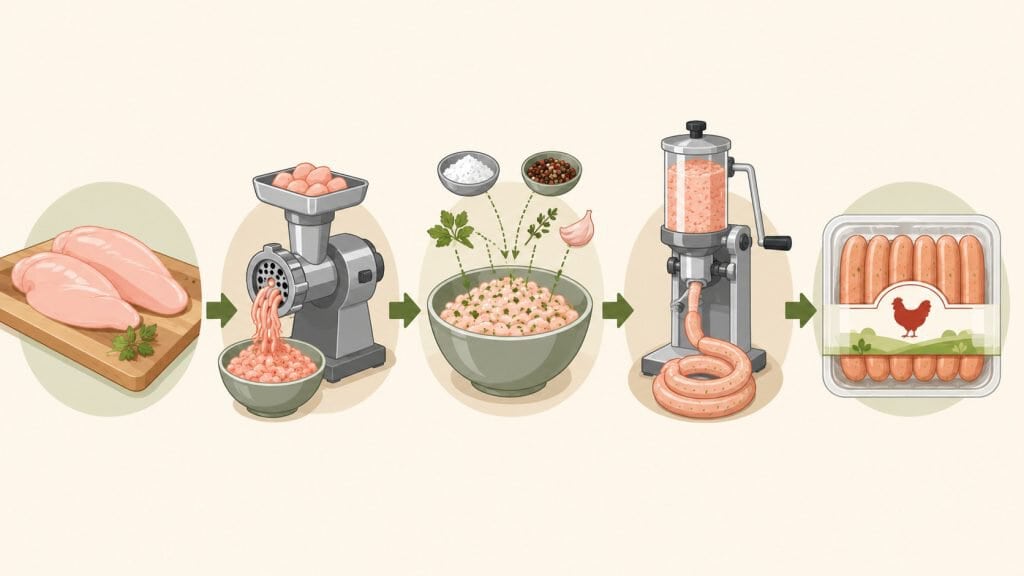
It’s processed because the chicken isn’t in its original form anymore. A chicken breast is just a chicken breast. To make it a sausage, that meat has to be ground into small pieces, mixed with other stuff, and forced into a casing. Then it’s almost always cooked, smoked, or treated with preservatives.
That whole journey, from a piece of meat to a packaged sausage, is what food scientists mean by “processing.” Once a food goes through several steps like that, it’s no longer considered unprocessed.
“Processed” Doesn’t Automatically Mean Unhealthy
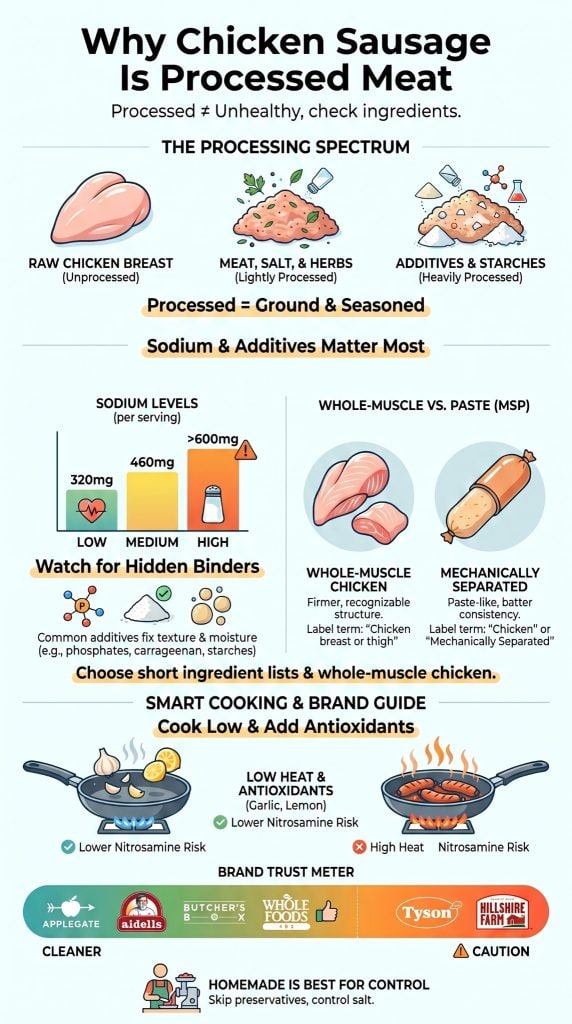
Think of “processed” as a scale, not a single box.
- Not processed: A raw chicken breast.
- Processed: A chicken sausage with just meat, salt, and herbs.
- Heavily processed: A sausage with a long list of additives, extra starches, and flavor chemicals.
Whether it’s healthy depends largely on sodium content, preservative use, filler ingredients, and overall nutritional composition. A sausage with chicken, garlic, and a pinch of salt is one thing. A sausage filled with binders, preservatives, and a ton of sodium is something else entirely.
Video Guide: Understanding the Reality of Processed Meat and Ingredient Quality
This video breaks down the nuances of highly processed meats, challenging the blanket assumption that all processed products are created equal. It explains how to look past misleading “health halo” packaging, emphasizing the importance of examining specific ingredient labels, filler contents, and manufacturing methods so you can make truly informed and healthier choices in the grocery aisle.
http://www.youtube.com/watch?v=ZUmuKt0svzw
Credit: KenDBerryMD
The “Health Halo” of Chicken Sausage
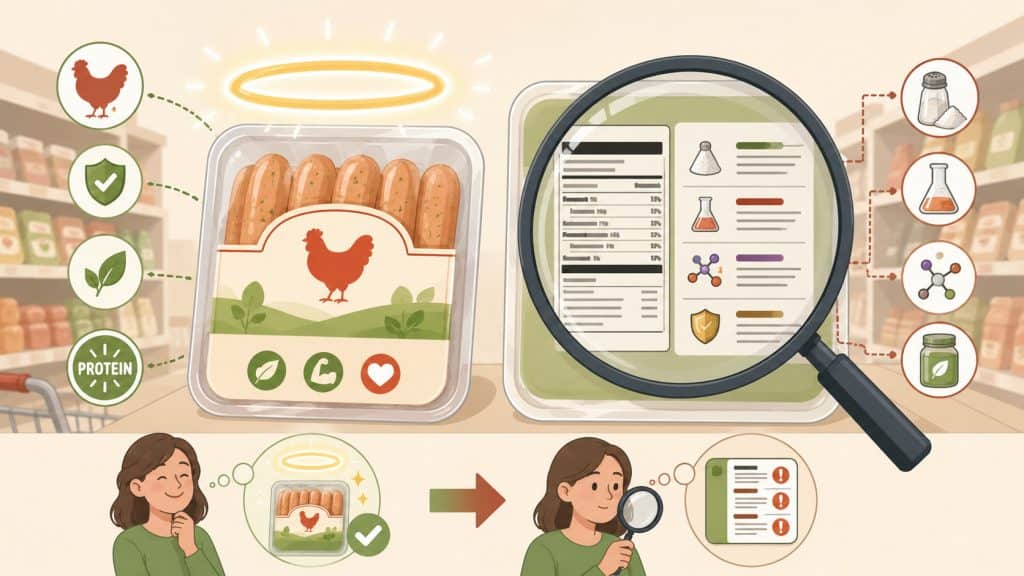
Chicken has a healthy reputation. That makes us think anything made from chicken must be good for us. That’s a “health halo.”
Swapping pork sausage for chicken sausage changes the animal, but not the factory methods. It still goes through the same grinding, seasoning, and preserving steps, though this varies significantly by brand and preparation. People assume it’s better because:
- Chicken is often lower in saturated fat than traditional pork sausage, though nutritional differences vary by product.
- The word “chicken” on the package sounds wholesome.
- The label often highlights protein content while drawing less attention to sodium levels or additives.
But a chicken sausage can still be packed with salt and additives. Don’t let the main ingredient fool you, check how it was made.
Even products marketed as healthy can vary considerably in sodium levels, preservatives, and overall ingredient quality.
Chicken Sausage Often Contains Additives
Ingredient composition varies significantly between brands depending on the meat source, additives, fillers, and preservation methods used.
| What’s Inside | Why It’s There |
| Chicken | It’s the main ingredient. |
| Salt | For taste and to preserve it. |
| Spices | Things like garlic or paprika for flavor. |
| Preservatives (like nitrites) | Common in cured sausages to keep color and stop bacteria. |
| Starches or Gums | Often added to make it juicier and hold it together. |
Common phosphate ingredients include sodium phosphate and related phosphate salts, while stabilizers may appear as carrageenan on ingredient labels.
| Entity | Attribute | Value |
| Phosphates | Function | Moisture retention |
| Phosphates | Label Appearance | Sodium phosphate, phosphate salts |
| Carrageenan | Function | Stabilizer |
| Carrageenan | Label Appearance | Listed as carrageenan |
Some brands keep it short: chicken, salt, spices. Others have a much longer list that can include:
- Water
- Sugar (dextrose)
- Soy protein
- Potato starch
- Phosphates
- “Natural flavor”
A shorter ingredient list typically indicates fewer preservatives, fillers, binders, stabilizers, and flavoring agents, making the product closer to simply seasoned chicken.
Mechanically Separated Chicken vs. Whole-Muscle Chicken
The term ‘chicken’ on a sausage label can refer to either whole-muscle meat or mechanically separated poultry, which differ in texture, processing level, and composition.
- Whole-Muscle Chicken: This is meat from recognizable cuts, like breast or thigh. It’s chopped or ground.
- Mechanically Separated Poultry (MSP): This is a paste made by forcing leftover chicken frames and carcasses through a machine to scrape off every bit of tissue. It’s a way to use all parts of the bird.
| Feature | Whole-Muscle Chicken | Mechanically Separated Chicken |
| What it is | Chopped chicken meat. | A fine, paste-like chicken product. |
| Processing | Minimal grinding. | Heavily processed. |
| On the Label | Will list “chicken breast” or “chicken thigh.” | Often just says “mechanically separated chicken” or “chicken.” |
Whole-muscle chicken generally produces a firmer texture and more recognizable meat structure than mechanically separated poultry.
| Entity | Attribute | Value |
| Whole-Muscle Chicken | Texture | Firmer meat texture |
| Whole-Muscle Chicken | Appearance | More recognizable meat structure |
| Whole-Muscle Chicken | Ingredient Perception | Often perceived as less processed |
As noted by USDA FSIS
“a product with a paste-like form and batter-like consistency” that results from mechanical separation, and that this product’s “form and texture differ materially from those of other boneless poultry products produced by traditional hand-deboning.” –USDA FSIS
Sausages made with MSP often need more binders and stabilizers to hold their shape. If you want a simpler product, look for one that names the specific cut of chicken.
Binders and Preservatives Fix Texture and Shelf-Life Problems
Chicken, especially breast meat, is very lean. It doesn’t have much natural fat or moisture. On its own, it would make a dry, crumbly sausage.
Manufacturers often add binders, moisture-retention agents, and preservatives to improve texture, juiciness, and shelf life:
- Starches, Gums, or Carrageenan: These act as binders. They trap water to make the sausage juicy and hold it together.
- Phosphates: These help the meat proteins hold onto moisture.
- Preservatives: They keep the sausage from spoiling quickly on the shelf.
These ingredients fix texture and shelf-life problems, but they also make the food more processed.
Products that rely heavily on multiple binders, stabilizers, preservatives, and flavoring agents are often considered more ultra processed than sausages made primarily from meat, herbs, and spices.
“No Nitrates Added” Labels Can Be Misleading
The ‘No Nitrates Added’ claim can be misleading because it relates to ingredient sourcing rather than whether curing compounds are ultimately present. Many sausages with this claim use ingredients like celery powder or celery juice instead.
Celery is naturally high in nitrates. During processing, these natural nitrates convert into the same preservative compounds (nitrites) as the synthetic versions. The sausage is still cured and preserved, just with a different starting ingredient. It doesn’t automatically mean the product is less processed.
The Main Health Concerns Are Sodium and Additives
From a clinical standpoint, the primary health concerns with chicken sausage aren’t about the chicken itself, but the chemical processing it undergoes.
- High Sodium: Many commercial chicken sausages contain substantial amounts of sodium, making sodium content one of the most important nutrition facts to review. A single link can dominate 25-60% of your USDA recommended daily salt intake.
- Additives: Some consumers choose to limit preservatives, phosphates, carrageenan, and other texture-modifying ingredients.
- Processing Level: Eating a lot of any processed meat, including chicken sausage, is linked to higher health risks if it replaces fresh foods in your diet.
| Concern | Key Attribute | Why It Matters |
| Sodium | Amount per serving | Can contribute significantly to daily sodium intake |
| Additives | Type and quantity | Some consumers prefer fewer additives |
| Consumption Frequency | How often eaten | Large, regular portions are the primary concern |
When comparing products, check both milligrams of sodium and percent Daily Value (%DV) on the Nutrition Facts panel. Taking a closer look at the nutrition label can also reveal differences in serving sizes, protein content, and ingredient quality between brands.
Research from Heliyon shows
“A study published in 2025 found that low-fat chicken sausages with 2% NaCl contained approximately 1185 mg of sodium per 100g, whereas formulations replacing half the salt with potassium chloride and other substitutes contained about 640 mg per 100g. This demonstrates that choosing the right brand can significantly reduce sodium intake.” –Heliyon
How You Cook It Matters: Nitrosamine Formation
The cooking method you use affects health risks beyond just the ingredients:
| Cooking Method | Effect | Recommendation |
| High-heat (grilling, frying above 350°F) | Increases nitrosamine formation from nitrites | Limit time at high heat |
| Moderate-heat (sautéing, 300-350°F) | Lower nitrosamine formation | Good balance |
| Low-heat (simmering, baking below 300°F) | Minimal nitrosamine formation | Best option |
| Adding antioxidants (garlic, lemon, turmeric) | Reduces nitrosamine formation | Include in recipe |
You Can Find a Higher-Quality Chicken Sausage
The following product attributes can help identify a less processed chicken sausage:
- Short ingredient list: The fewer things listed, the better.
- Identifiable chicken: “Chicken breast” or “chicken thigh” is better than just “chicken.”
- Lower sodium: Compare brands and pick one with less salt per serving.
- Few fillers: Avoid long lists of starches, gums, and soy protein.
Brands with Cleaner Ingredient Lists
Based on ingredient analysis, these brands tend to have shorter, cleaner lists:
| Brand | Why It’s Better | Sodium per Serving |
| Applegate Naturals | “Chicken breast” listed specifically; no phosphates; no MSG | ~380mg (16% DV) |
| Aidells | Short ingredient list; uses whole-muscle chicken | ~450mg (19% DV) |
| Butcher’s Box | 100% organic chicken breast; no additives | ~320mg (14% DV) |
| Whole Foods 365 | Simple ingredients; minimal processing | ~400mg (17% DV) |
Brands to avoid or check carefully:
Tyson, Hillshire Farm, and some Dollar Store brands often contain mechanically separated chicken, multiple starches, and higher sodium (500-600mg+).
Homemade Chicken Sausage Is Usually Less Processed
Homemade chicken sausage provides direct control over meat selection, sodium levels, seasoning, preservatives, and fillers.
- You choose the cut of chicken.
- You decide how much salt and which herbs to use.
- You skip the preservatives, binders, and fillers.
Homemade lasts 2-3 days refrigerated vs. weeks for store-bought. But for ingredient control, it’s the best option.
| Factor | Homemade | Store-Bought |
| Ingredients | You are in charge. | Controlled by the factory. |
| Sodium | You decide how much. | Usually very high. |
| Preservatives | You can skip them. | Almost always included. |
| Shelf Life | A few days. | Weeks or months. |
FAQ
Can you freeze fresh, minimally processed chicken sausage, and how does it affect texture?
Yes. Because high-quality brands omit the industrial gums and water-binding phosphates found in heavy processing, freezing them can slightly alter their moisture content. I recommend wrapping them tightly in butcher paper and consuming them within three months to prevent freezer burn.
How can I identify minimally processed chicken sausage?
You can identify minimally processed chicken sausage by reading the chicken sausage ingredient list. Products in this category usually contain chicken, herbs, spices, and a small number of additional ingredients. They generally contain fewer chicken sausage additives, fillers, binders, emulsifiers, stabilizers, and preservatives than heavily processed products. Clear chicken sausage labeling makes it easier to compare products and understand what you are buying.
What ingredients should I check before buying chicken sausage?
Before buying chicken sausage, review the chicken sausage ingredients carefully. Look for chicken sausage preservatives, nitrates, nitrites, fillers, binders, flavorings, and other food additives. You should also check the chicken sausage sodium content because some products contain large amounts of added salt. Reading the ingredient list and nutrition panel allows you to compare products and make a more informed choice.
Does chicken sausage have different nutrition than pork sausage?
Yes, chicken sausage versus pork sausage often differs in calories, protein, fat, cholesterol, and sodium levels. Chicken sausage is frequently marketed as a lean protein sausage because it can contain less fat than pork sausage. However, nutritional values vary by recipe and manufacturing method. Reviewing chicken sausage nutrition facts is the most reliable way to compare two products accurately.
What affects the shelf life of chicken sausage?
Chicken sausage shelf life depends on the processing method, packaging, preservatives, and storage conditions. Fresh chicken sausage usually spoils faster because it does not undergo the chicken sausage curing process or smoking process used for some other varieties. Processed poultry products that are cured, smoked, or packaged in sealed containers generally remain safe to eat for longer periods when stored properly.
Make a Better Choice Without Overthinking It
Buying chicken sausage can feel confusing when the packaging makes every option look healthy. The problem is that what’s on the front doesn’t tell the full story. A quick look at the ingredient list and sodium content can save you from picking a product that’s loaded with unnecessary additives.
The good news is that making a better choice doesn’t take much effort. Next time you’re shopping, compare two packages side by side and focus on what’s actually inside. That simple habit can help you find a chicken sausage that’s closer to real chicken, with fewer extras and a nutrition label you can feel better about.
Related Articles:
- https://milkwoodrestaurant.com/is-chicken-sausage-ultra-processed/
- https://milkwoodrestaurant.com/chicken-sausage-nutrition-label/
- https://milkwoodrestaurant.com/is-chicken-apple-sausage-healthy/
References:
- https://www.govinfo.gov/content/pkg/FR-1995-11-03/pdf/95-27305.pdf#8#1
- https://www.sciencedirect.com/science/article/pii/S2405844025001768