A single chicken sausage link usually has about 70 to 180 calories, depending on size and brand. But the exact number depends on its size, what’s inside it, and the brand that made it. Most of the gap comes down to serving size, which catches a lot of people off guard.
Check the nutrition label before comparing products. Keep reading to learn how to estimate calories more accurately, compare labels, and pick the chicken sausage that fits your goals.
Chicken Sausage Calories: Quick Facts Before You Buy
Chicken sausage calories can vary more than many people expect, so checking the nutrition label helps you compare products accurately and choose the option that best fits your health goals.
- Most chicken sausage links calories fall between 70 and 160 calories per link, with full-size links averaging 130–150 calories.
- Checking the chicken sausage nutrition label is more reliable than relying on package marketing because serving sizes differ widely.
- A high protein chicken sausage with lower fat and reasonable sodium can fit weight-loss, diabetes, and balanced eating plans.
How Many Calories Are in a Chicken Sausage Link?
You’ll see numbers from 70 all the way up to 160. That’s a big difference. What’s going on?
Link mass dictates total caloric value. Volumetric size directly correlates with energy density. Department of Agriculture (USDA) databases verify this linear relationship. Heavy links inherently yield higher calorie profiles. Evaluating products by their exact physical weight in grams eliminates tracking errors.
Here’s a basic guide based on weight:
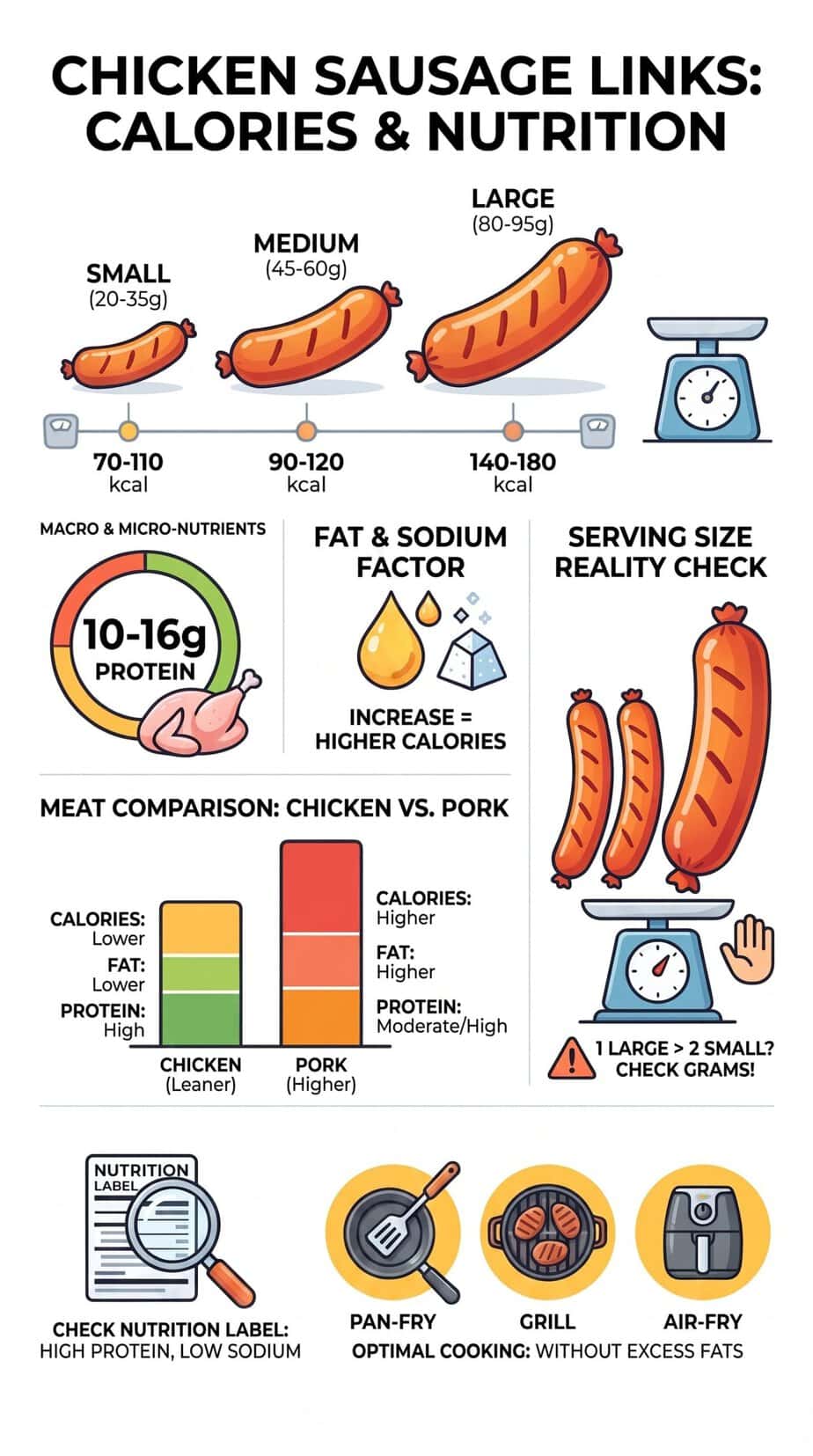
- Small breakfast links (about 20–35 grams): These are usually 70 to 110 calories.
- Medium links (about 45–60 grams): You’re looking at 90 to 120 calories here.
- Full-size links (about 80–95 grams): These can be 140 to 180 calories.
Now, here’s the part that confuses everyone: the serving size. One brand might say a serving is “one link (85g).” The brand next to it might say a serving is “two links (40g).” Some very small or smoked links may be as low as 50–70 calories, but these are not typical full-size links.
If you don’t look, you’ll think the first one has way more calories, but you’re not comparing the same amount of food. Always check the serving size and the weight in grams first.
What makes one sausage higher in calories than another?
- What’s in it: A plain chicken sausage is the leanest. Add-ins like cheese, sun-dried tomatoes, or a sweet glaze add calories.
- Fat content: Some brands use more thigh meat or add oil.
- How it’s prepared: Smoked or pre-cooked varieties sometimes have extra sugar or oil in the process.
- The serving size definition: This is just how the company chose to do the math on the label.
The trick is to ignore the “per link” part at first. Find the “Serving Size” line and look at the weight in grams. Compare that number between brands. Once you know you’re looking at the same amount of food, you can see which one has more protein, less saturated fat, and a calorie count that fits what you’re looking for. If you’re comparing several products, paying close attention to the chicken sausage nutrition label makes those differences much easier to spot.
Why Chicken Sausage Calories Vary

You’d think a chicken sausage link would have a standard number of calories, but it doesn’t. The count can swing wildly, and it mostly comes down to two things: fat and portion size.
Fat is the main driver. Sausage recipes balance fat for moisture and taste. More fat in the mix means more calories in every bite. For instance, 100 grams of a plain, lean chicken sausage might be about 150 calories. That same 100 grams of a cheesy, oil-packed variety could be 220 calories or higher.
What pushes the fat content up?
- Using darker, fattier chicken meat.
- Blending in pork fat or added oils.
- Including cheese or creamy fillings.
- Sweeteners like maple syrup or fruit purees.
Here’s the catch: the calorie number alone can be misleading. Two sausages might both say “140 calories,” but one could give you a good amount of protein to keep you full, while the other is mostly fat and salt with very little protein.
If you want to make a smart choice, don’t stop at the calorie count. Turn the package over and compare these five lines on the Nutrition Facts:
- Total Fat and Saturated Fat
- Protein
- Total Carbohydrates (and Sugars)
- Sodium
- The Serving Size weight in grams
Looking at all of that gives you the real story. You can see if you’re choosing something lean and satisfying, or something that’s just empty calories dressed up as health food.
How Serving Size Changes Chicken Sausage Calories
Many calorie-tracking mistakes happen because packages list calories per serving, not per individual link. The Nutrition Facts panel should always be the first place to check before logging food.
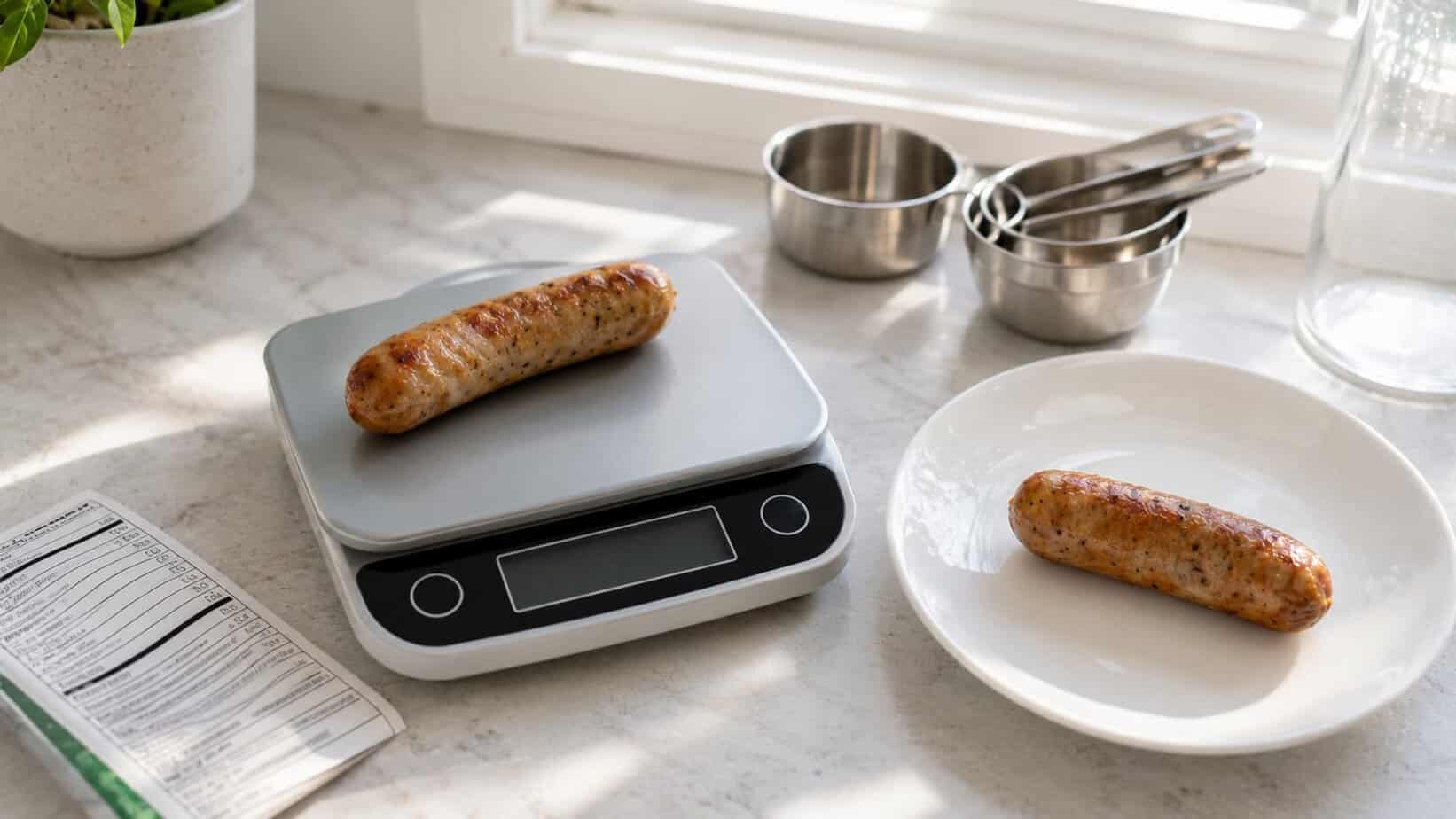
Industrial packaging guidelines allow manufacturers to define servings by variable units rather than uniform weights. A brand selling three miniature breakfast links may display a total calorie count identical to a competitor selling a single, dense dinner link. Shifting the evaluation entirely to a standardized mass metric eliminates this visual confusion instantly.
But the first one, those three small links, might weigh half as much. So, calorie for calorie, the smaller ones could actually be more dense. The word “link” doesn’t mean a standard size. One link here is a snack, one link there is a meal.
Research from PubMed
“The only thing that doesn’t change is weight. So you have to find the ‘Serving Size’ line and look at the grams.” – PubMed
So you have to find the “Serving Size” line and look at the grams.
Make it a habit. Before you buy or log it, check:
- How many links are in a serving?
- What’s the weight in grams?
- What’s the calorie count for that?
Then, if you want, do the quick math for one link or for 100 grams to compare brands evenly. It takes ten seconds and it stops you from being totally wrong about what you’re eating. The label has the answer, you just have to read the right part.
How to Find a Lighter Chicken Sausage
You want a chicken sausage that’s lower in calories. They exist. But you can’t just pick a brand and assume it’s the lightest one. You have to read the back of the package, every single time. The recipe from last year might be different now.
Start with the protein. Look for a sausage that gives you a good amount per serving, more protein means it’ll keep you full. After you find a few with decent protein, then compare their calories, fat, and sodium.
Some common brands that often have lighter options are Amylu, Bettergoods, and Jones Dairy Farm. But their products aren’t all the same, so you still have to check.
Here’s a basic guide to what you might see:
| Brand | Usual Calories (per serving) | The Details |
| Amylu | 120–130 | Look for their “high protein” varieties. |
| Bettergoods | Varies (patties ~80 cal/40g) | Check labels for links specifically. |
| Jones Dairy Farm | ~110 calories per 4 links (breakfast-sized) | Check serving size carefully. |
Here’s the important part: don’t choose based on calories alone. A sausage with 150 calories could be a much smarter choice than one with 130. Why? The 150-calorie one might have 5 more grams of protein, way less sodium, and an ingredient list that’s just “chicken, spices” instead of a paragraph of additives.
Smart meal prep relies on chicken sausage as a quick, satisfying protein that adds bulk to a plate without overloading it with calories. Instead of doing math in the grocery aisle, checking the nutrition label for a standard 100-gram baseline instantly reveals whether a brand is packed with fillers.
In the kitchen, pre-cooked links pair best with high-volume, low-calorie vegetables rather than heavy dairy additions that mask the sausage’s natural flavor profile. Slicing the links into uniform half-inch rounds and searing them over medium-high heat for 4 minutes allows the natural sugars to caramelize without adding extra cooking oils.
These crisped rounds serve as an excellent structural base for high-volume sheet pan meals, tossed alongside dense vegetables like broccoli florets, cubed zucchini, and sliced bell peppers, ensuring a highly filling, macro-friendly meal.
The best one isn’t the one with the lowest number. It’s the one that gives you the most of what you need (like protein) and the least of what you don’t (like extra salt and fillers).
Chicken Sausage vs. Pork Sausage: The Calorie Question
Here’s the simple answer: chicken sausage usually has fewer calories and less fat than pork sausage. But that “usually” is doing a lot of work.
It all depends on what’s actually in the tube. A basic chicken sausage is leaner. But a fancy chicken sausage stuffed with cheese and glazed with maple syrup can easily have more fat and calories than a plain pork bratwurst. Though this is less common; most chicken sausages remain lower in calories than pork equivalents.
The data shows this. Nutrition databases track “reduced-fat poultry sausage” as its own category because it consistently has a better fat profile than traditional pork.
Here’s what you typically see:
| What you’re looking at | Chicken Sausage | Pork Sausage |
| Calories | Tends to be lower | Tends to be higher |
| Fat | Tends to be lower | Tends to be higher |
| Protein | Roughly the same | Roughly the same |
| Cholesterol | Often lower | Often higher |
| Sodium | Varies widely for both | Check labels as some chicken sausages are high in sodium |
Evaluating the raw numbers reveals the true nutritional spread between the two proteins. On average, a standard 100-gram serving of chicken sausage delivers 140 to 160 calories and 7 to 9 grams of total fat.
By comparison, the same 100-gram serving of traditional pork sausage yields roughly 290 to 330 calories and a much heavier 22 to 26 grams of fat. While both options supply a comparable 14 to 16 grams of protein, chicken sausage offers a significantly leaner protein-to-calorie ratio.
The big mistake is thinking “chicken” always means “diet food.” It doesn’t. A chicken sausage with added bacon and oil defeats the whole purpose.
Flavors matter, too. A spicy Italian chicken sausage will have a different nutrition profile than a sweet apple chicken sausage from the same brand. Comparing different chicken sausage types also helps explain why calories, fat, and sodium can vary so much even within a single brand.
So how do you really know? You have to compare the labels. Look at the serving size weight in grams first to make sure you’re comparing equal amounts. Then, look past the calories. Check the saturated fat, the protein, and the sodium.
Sometimes, you might find a lean pork sausage that’s lower in sodium and has cleaner ingredients than a processed chicken sausage. In that case, the pork might be the smarter choice. The type of meat is a starting point, but the fine print is what counts.
Figuring Out Calories Without the Package

What if you have chicken sausage but no nutrition label? You can still get a close estimate. You’ll need a kitchen scale and a good guess for a reference number.
Here’s what you do:
- Weigh the sausage. Use a kitchen scale to find out how many grams one link is.
- Pick a reference calorie count. Think about what kind of sausage it is. Is it a plain one? A cheesy one? A good average to start with is 180 calories for every 100 grams of cooked chicken sausage.
- Do a quick calculation.
- Take the weight of your sausage (in grams).
- Multiply it by your reference number (like 180).
- Divide that answer by 100.
For example:
You have a sausage that weighs 50 grams.
(50 grams × 180 calories) ÷ 100 = 90 calories.
Your estimated total is about 90 calories.
This isn’t a perfect science. A sausage loaded with cheese and oil will have more calories per gram. A very plain, lean one will have fewer. But for a rough idea, like planning a meal, it works just fine.
Most regular chicken sausages are between 150 and 220 calories per 100 grams. Starting with 180 gives you a useful middle ground when the label is gone. Leaner brands may be closer to 150–170 cal/100g, while richer varieties can reach 200–220 cal/100g.
What to Really Look at on the Label
Everyone looks at the calories first. That’s fine. But if you stop there, you’re missing the point.
The other numbers tell you what the food is actually made of. A chicken sausage link will give you protein, anywhere from 10 to 16 grams, usually. That’s what makes it filling. But you should also look at the sodium.
Some sausages pack a large amount of sodium into one link, ranging from under 100 mg to more than 500 mg depending on the recipe. Comparing the sodium amount with the Daily Value on the Nutrition Facts label helps you see how much one serving contributes to your daily intake. The fat, especially saturated fat, is worth a glance too.
Here’s a quick checklist for when you’re holding the package:
- Protein: Aim for at least 10–14g protein per link for a filling option.
- Sodium: How much of your daily salt is in this one link?
- Fat: Look at the “Saturated Fat” line specifically.
- Carbs/Sugars: If it’s a plain sausage, this should be low. If it’s a sweet flavor, this number will be higher.
- Serving Size: Always check the grams. Is this for one link or two?
Does it have protein?
Yes, that’s the main reason to choose it over other breakfast meats. It’s a good source.
Are there carbs?
In a basic chicken sausage, barely any. The carbs come from added ingredients like fruit, honey, or maple syrup. If you see those in the ingredients, check the sugar grams.
Navigating processed meats requires a careful balance between dietary efficiency and cardiovascular health. While chicken sausage serves as an excellent tool for caloric restriction and muscle retention, managing daily sodium intake remains a critical metric for long-term wellness.
Consulting a registered dietitian can help integrate these convenient proteins into a specialized meal plan without exceeding recommended daily sodium baselines. Sometimes the sausage with 20 more calories is the much better deal.
So, Is Chicken Sausage Healthy?
It can be. For many, it’s a step up from pork sausage, often leaner, with good protein. But calling it “healthy” is a stretch for some varieties.
People wonder:
- Is it actually good for you?
- Can it help with weight loss?
- Why is it supposedly better?
The answer isn’t simple. It hinges on the specific sausage in your hand.
What makes one healthy and another not?
- What’s inside: A sausage containing just chicken, salt, and spices is one thing. A sausage with “dextrose,” “isolated soy protein,” and a paragraph of ingredients is another.
- The salt: This is the biggest issue. Many brands cram a shocking amount of sodium into each link.
As noted by Hong Kong Government’s Elderly Health Service
“The salt: This is the biggest issue. Many brands cram a shocking amount of sodium into each link.” – Hong Kong Government’s Elderly Health Service
- How much you eat: A single link is reasonable. Making a meal out of three or four is a heavy load of processed meat.
- The rest of your diet: It’s one piece of your day.
Will it help you lose weight?
Poultry-based sausages facilitate fat loss by optimizing the thermic effect of food (TEF) and stimulating satiety hormones like peptide YY. Substituting lean chicken for traditional pork reduces total caloric density per meal, supporting a sustained energy deficit. Achieving this metabolic benefit requires selecting links with low fat-to-protein ratios and strictly regulating portion mass to avoid accidental caloric surpluses.
In that case, it’s a convenient protein source. But a fatty, salty, hyper-processed chicken sausage isn’t a health food. It’s just processed meat from a different animal.
Chicken Sausage Recipes and Meal Ideas
Chicken sausage is an easy protein to keep in the fridge. Most varieties are fully cooked, so you can heat them in a pan, microwave, or air fryer whenever you need a quick meal. It also works well as chicken breakfast sausage during breakfast time, but it is just as convenient for lunch or dinner. Here’s how normal people actually use it.
Quick meal ideas
- Breakfast: Chop one up and scramble it with eggs. Or slice it and pan-fry it next to some potatoes.
- Lunch: Slice a link over a bowl of cottage cheese. Add pepper. It’s weirdly good.
- Dinner: The easiest move is to slice it and toss it into whatever you’re already making. Pasta, fried rice, soup, a tray of roasted vegetables. It works in all of them.
Cooking it is simple
Your goal is just to warm it through and get it a little crispy.
- In a pan: Slice and cook over medium heat for 3–5 minutes, until heated through and golden brown on both sides.
- In the air fryer: 375°F for 8-10 minutes.
- In the oven: 400°F for 15-20 minutes.
- On the grill: 10-12 minutes, turning it a few times.
Making your own is an option
IIf you want to control the salt and ingredients, making homemade chicken sausage is one of the easiest ways to customize protein, sodium, and seasonings to match your nutrition goals.
Mix a pound of ground chicken with a teaspoon of salt, dehydrated garlic, smoked paprika, black pepper, and chopped parsley. Skip added sugar if you want to keep the recipe lower in carbohydrates. Form into small patties and cook in a lightly oiled pan for about 4-5 minutes per side, until cooked through.
The point is convenience. Cook a pack at the start of the week, and you’ve got a ready-made protein to add to anything. It keeps meals from feeling like a chore.
Watch: How to Make Low-Calorie, High-Protein Breakfast Chicken Sausage Links From Scratch
Credits: Abena Tinaa
This video shows you how to make juicy breakfast chicken sausage links completely from scratch using lean ground chicken breast and a custom blend of flavorful spices. Preparing them at home allows you to skip the hidden calories, heavy oils, and processing additives frequently found in pre-packaged grocery store brands. It is a perfect visual guide for anyone looking to maintain total control over their daily macronutrient intake.
Using Chicken Sausage for Weight Loss
Can you eat chicken sausage and still lose weight? Sure, but you have to be careful with it.
The protein in it helps you feel full, which is a plus when you’re cutting calories. But the calories in the sausage itself can sneak up on you if you’re not paying attention.
Here’s how to make it fit
- Stick to one link. Maybe two if they’re very small. That’s your portion.
- Cook it simply. Throw it on the grill, bake it, or use an air fryer. Don’t fry it in a bunch of oil.
- Build your plate around it. The sausage shouldn’t be the whole meal. Use it as the protein part.
What to eat with it
Fill the rest of your plate with things that have few calories but lots of volume.
- A heap of vegetables (think broccoli, zucchini, a big salad)
- A couple of scrambled eggs
- A small scoop of a whole grain like farro or barley
- Some fresh fruit or a bit of plain yogurt
Picking the right sausage matters
If you’re looking for the best one to help with weight loss, you need to read the fine print. The words “healthy” or “natural” on the front don’t mean much.
Turn the package over. Look for:
- A decent amount of protein (aim for at least 12-15 grams per serving).
- A serving size that’s realistic (one link, not half of one).
- The lowest numbers you can find for sodium and saturated fat.
Satiety depends heavily on protein density. A 150-calorie link with 14 grams of protein provides superior metabolic value over a lower-calorie alternative lacking structural macronutrients. Protein slows down digestion rates. Choosing the dense option suppresses hunger longer.
The basic rule is this: chicken sausage can be a convenient protein source in a balanced diet. But it’s still processed meat, and understanding what goes into processed chicken sausage can help you make better choices about ingredients, sodium, and portion size. Use it as a helper, not the main event, and always check what’s really in it.
Track Calories With More Confidence
Watching chicken sausage links calories gets much easier when you rely on the nutrition label instead of guessing. A small difference in serving size or ingredients can change the numbers more than you expect. That’s why checking the Nutrition Facts panel before you buy is worth it.
If you want a simple way to compare options, Milkwoodrestaurant can help you find chicken sausage brands that fit your nutrition goals. A quick comparison today can make your next meal a better match for the way you want to eat.
FAQ
Is chicken sausage processed or ultra-processed?
Most chicken sausage is considered processed because the meat is ground, seasoned, and packaged before sale. Whether chicken sausage is processed food or ultra-processed depends on the ingredient list. Some recipes contain only chicken, herbs, and spices, while others include preservatives, fillers, or flavor enhancers. Reading the chicken sausage ingredients helps you choose a simpler, healthier option.
Is chicken sausage low in sodium?
Chicken sausage is not always low in sodium. Some varieties contain as much sodium as traditional sausage, while others are made as chicken sausage with low sodium. If you are asking is chicken sausage low in sodium, compare the chicken sausage nutrition label and choose products with less sodium per serving. This is especially important if you are managing blood pressure. Sodium content per serving must be evaluated against the American Heart Association (AHA) absolute daily threshold of 2,300 mg, with an ideal limit of 1,500 mg for individuals managing hypertension. A single highly processed link containing 500 mg of sodium accounts for over 33% of that restricted daily allowance.
Can you eat chicken sausage during pregnancy?
Pre-cooked and raw chicken poultry products are safe for consumption during pregnancy only if heated to an internal temperature of 165°F (74°C) measured by a calibrated food thermometer. According to Food and Drug Administration (FDA) food safety guidelines, this thermal threshold is required to eliminate Listeria monocytogenes, a foodborne pathogen capable of surviving cold refrigeration environments in processed meats.
Is chicken sausage easy to digest?
Gastrointestinal transit and ease of digestion depend directly on a sausage’s fat ratio, casing type, and spice profile. Lower fat content minimizes delayed gastric emptying, making lean poultry fundamentally lighter on the stomach than high-fat pork. However, commercial casings made of tough collagen can irritate sensitive digestive tracts. For individuals managing IBS or acid reflux, avoiding links processed with high-FODMAP structural fillers, such as isolated soy protein, garlic powder, or onion extracts, is critical to preventing inflammatory flare-ups.
Related Articles
- https://milkwoodrestaurant.com/chicken-sausage-nutrition-label/
- https://milkwoodrestaurant.com/chicken-sausage-types-and-varieties/
- https://milkwoodrestaurant.com/are-chicken-sausages-processed/
- https://milkwoodrestaurant.com/how-to-make-chicken-sausage-at-home/
References
- https://pubmed.ncbi.nlm.nih.gov/39897823/
- https://www.elderly.gov.hk/english/
Was this helpful?

I’m Mary R. Q. , a seasoned professional chef dedicated to elevating home cooking experiences. Through my expertise in the culinary arts, I provide practical cooking tips and insightful reviews of kitchen utensils on my blog, milkwoodrestaurant.com. As a passionate advocate for transforming everyday meals into extraordinary culinary adventures, I aim to empower home cooks with the knowledge and tools they need to create delicious and memorable dishes. I’m also an author of the book “1,001 Kitchen Tips & Tricks: Helpful Hints for Cooking, Baking, and Cleaning (1,001 Tips & Tricks)” which is sold on Amazon. Join me on a flavorful journey as we explore the art of cooking and the essential tools that make it a joy.